

Artificial Intelligence

Refers to computer systems designed to perform tasks that normally require human intelligence—like understanding language, recognising patterns, solving problems, or making predictions.
AI has evolved into today’s advanced machine-learning systems capable of language understanding, image recognition, and autonomous decision-making. Its development includes theoretical foundations, periods of rapid progress, setbacks, and modern breakthroughs driven by data and computing power. Today, the key task is to determine where this technology can be used efficiently and for what purposes.

Artificial Intelligence
What Artificial Intelligence can be used for
1.Automation of Tasks
- Replacing repetitive or routine work
- Examples: data entry, scheduling, customer support chatbots
2. Healthcare
- Diagnosing diseases
- Analysing medical images (like X-rays or MRIs)
- Drug discovery and personalised treatment plan
3. Education
- Personalised learning experiences
- AI tutors and grading systems
- Language learning apps
4. Business & Finance
- Fraud detection
- Stock market analysis
- Customer behaviour prediction
- Automated trading
5. Transportation
- Self-driving cars
- Traffic prediction and route optimisation
- Smart logistics and delivery systems
6. Entertainment
- Movie and music recommendations
- Video game AI
- Content creation (art, music, writing)
7. Natural Language Processing
- Chatbots and virtual assistants
- Language translation
- Voice recognition (like speech-to-text)
8. Security
- Facial recognition
- Cybersecurity threat detection
- Surveillance systems
9. Manufacturing
- Robots in factories
- Quality control using computer vision
Predictive maintenance
10. Everyday Applications
- Smart home devices
- Email spam filters
- Navigation apps

To think of when using AI


There are some important things to keep in mind so you use it safely, ethically, and effectively.
1.Accuracy
2.Privacy
3.Bias & fairness
4.Transparency
5.Responsibility
6.Safety & misuse
7.Copyright & ownership
8.Use it as a tool
Use AI like a smart assistant — helpful, fast, but not always right and not responsible for your decisions.


1.Accuracy
AI can sound confident even when it’s incorrect.
1.Always double-check important facts
2.Don’t rely on AI for critical decisions (health, legal, finance) without verification
3.Treat it as a helper, not a final authority

2. Privacy — be careful what you share
Anything you input might be stored or processed.
1.Don’t share sensitive info (passwords, personal data, company secrets)
2.Be cautious with confidential work material
3.Follow your workplace or school policies

3.Bias & fairness
AI systems can reflect biases from their training data.
1.Be aware that outputs might be unfair or one-sided
2.Avoid using AI blindly for decisions about people (e.g. hiring)
3.Question results, especially in sensitive contexts

4. Transparency — know when AI is used
This is actually part of EU rules under the EU Artificial Intelligence Act.
1.Inform others if content is AI-generated
2.Label deepfakes or synthetic media
3.Don’t mislead people into thinking AI output is human

5. Responsibility — you are accountable
Even if AI helps, you are responsible for how it’s used.
1.Check outputs before sharing or acting on them
2.Make sure your use follows laws and rules
3.Be especially careful in professional settings

6. Safety & misuse
AI can be misused if you’re not careful.
1.Don’t use it to harm, scam, or manipulate
2.Avoid generating misleading or harmful content
3.Think about real-world consequence

7. Copyright & ownership
AI content can raise legal questions.
1.Don’t assume AI-generated content is always free to use
2.Be careful copying text, images, or code
3.Respect intellectual property rights

Best results come when AI supports your thinking.
1.Use it for brainstorming, learning, drafting
2.Combine it with your own judgement and knowledge
3.Stay critical and engaged
Types of AI


We are in the beginning of the Artificial Intelligence Development
So I am quite sure this will evolve

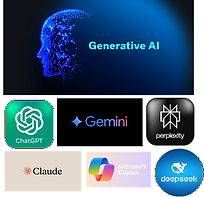
Generative AI = AI that can create new content
Pre-trained models (most common)
- They are trained on large amounts of data in advance
- They do not actively search the internet when you ask a question
- They respond based on what they have already learned
AI with search functionality (retrieval / browsing)
- These can retrieve up-to-date information from the internet in real time
- They use something called retrieval-based AI or web search
Built using techniques from Machine Learning and Natural Language Processing.
How it works:
1.Learns patterns from massive amounts of text
2.Predicts the next word in a sentence
3.Generates answers dynamically
Strengths:
1.Explains things clearly
2.Can write, summarise, translate
3.Handles complex, open-ended questions
4.Feels like a conversation
Weaknesses:
1.Can “hallucinate” (make things up)
2.Doesn’t always know what’s true vs likely
3.May be outdated or inconsistent
It is a very smart writer that sounds right but isn’t always guaranteed to be right.
Products:
ChatGPT
Google Gemini
Claude
Microsoft Copilot
Perplexity AI
DeepSeak

Analytical AI = analyses data
What it means
- It relies on stored, organized information (like tables, records, or knowledge
bases)
- The facts are usually verified and curated
- It retrieves exact data rather than “guessing” from patterns
Fact-database AI (retrieval-based AI)
More like a smart search system connected to real data.
How it works:
Pulls information from:
Databases
Documents
Verified sources
Often shows references or citations
Strengths:
More accurate for factual queries
Uses up-to-date or controlled data
Easier to verify information
Weaknesses:
Less flexible in conversation
Struggles with creative or complex explanations
Depends heavily on the quality of its data sources
A precise librarian that gives you real sources but doesn’t “think” creatively.

Leadership style and AI
Before, leaders were expected to have answers.
With AI, strong leaders focus more on framing the right questions, checking assumptions, and interpreting results
1. More data-driven, less gut-only
- balancing data with human judgement
2. Faster decisions, shorter cycle
AI speeds up analysis so that:
- decisions are made quicker
- adjust strategies are done more often
- lead in real time, not yearly plans
That means being more agile and comfortable with change.
3. Stronger focus on ethics and responsibility
- setting ethical boundaries
- ensuring accountability
- protecting human values
4. Skills become more importent
- Djudjing wether information are trustworthy
- Communication skills
- Emotional intelligence

When not to use Artificial Intelligence (AI)
1. When human judgement is critical
- Ethical decisions
- Life-changing choices (medical, legal, disciplina)
- AI can support, but humans must decide.
2. When empathy and emotional understanding matter
- Conflict resolution
- Counseling or therapy
- Sensitive feedback (layoffs, personal crises)
AI can’t genuinely understand emotions or build trust.
3. When data is poor, biased, or missing
- Small datasets
- Biased historical data
- New or unique situations
- In new innovations
Bad data → bad AI decisions.
4. When transparency is required
- Legal decisions
- Government or regulatory contexts
- High-risk accountability situations
If you can’t explain why a decision was made, AI may not be appropriate.
5. When creativity must be original or deeply human
- Core artistic vision
- Personal storytelling
- Cultural or moral expression
AI can help, but relying on it too much can reduce authenticity..
-
6. When privacy or security is at risk
- Sensitive personal data
- Confidential business information
- National security contexts
AI use here requires strict controls — or no use at all
7. When speed is less important than reflection
- Long-term strategy
- Value-based leadership decisions
- Complex social issues
Fast answers aren’t always the right ones.
Pays attention to details and avoids mistakes.


Regulation in EU
risk-based
1) Unacceptable risk — These uses are illegal in the EU.
Examples include:
1.Social scoring of citizens
2.Manipulative AI that exploits vulnerable people
3.Emotion recognition at work or school
4.Predictive policing based only on personal data
5.Some biometric surveillance in public
2) High-risk AI — Strict rules
Allowed, but heavily regulated.
Examples:
1.AI used in hiring or education
2.Medical AI
3.Credit scoring systems
4.Critical infrastructure (transport, energy)
5.Law-enforcement tools
6.Requirements include:
7.Risk assessments
8.Human oversight
9.High data quality
10.Documentation and testing
11.Registration in EU databases
3) Limited-risk AI — Transparency required
Users must know they’re interacting with AI.
Examples:
1.Chatbots
2.AI customer service
3.Deepfake content
4.Companies must clearly disclose AI use (e.g., “This is AI-generated”).
4) Minimal-risk AI — Mostly free to use
Low-risk tools face little regulation.
Examples:
1.Spam filters
2.AI in video games
3.Recommendation systems
Special rules for generative AI (ChatGPT-like systems)
Large AI models have extra obligations:
1.Disclose training data sources
2.Respect copyright opt-outs
3.Label AI-generated content
4.Assess risks from powerful models
Organisations using AI in the EU may need to:
1.Ensure systems are safe and non-discriminatory
2.Keep records and technical documentation
3.Allow human oversight
4.Train staff in AI literacy
5.Report serious incidents
The law applies even to companies outside the EU if their AI affects EU users.
strict & comprehensive


Regulation in US
More business-friendly but less consistent
1.Mix of federal guidance + state laws
2.Focus on innovation and competition
3.Rules on privacy, discrimination, and safety
4.Different laws in different states

Regulation in China
strict & government-controlled
Mandatory government oversight
1.AI must follow “social stability” rules
2.Strict regulation of generative AI and algorithms
3.Deepfake and recommendation systems heavily regulated
Focus on control and political stability

Regulation in United Kingdom
light & sector-based
1.No single AI law (like the U.S.)
2.Regulators in each sector (health, finance, etc.)
3.Emphasis on innovation and guidelines
“Wait and adapt” strategy
United Kingdom uses a flexible approach

Regulation in Canada
risk-based
Regulation in Canada — risk-based
1.Canada is working on new AI laws.
2.Proposed AI law (AIDA)
3.Focus on high-risk AI systems
4.Transparency and accountability rules
Similar direction to EU, but not fully implemented yet

Regulation in Japan
soft regulation
Japan takes a lighter approach.
1.Guidelines instead of strict laws
2.Strong support for AI innovation
3.Encourages responsible use
Business-friendly and flexible

Regulation in South Korea
balanced approach
South Korea is building structured AI rules.
1.AI Act under development
2.Focus on ethics + innovation
3.Support for AI industry growth

There’s no single global AI law — instead:
Some regions (like EU) regulate heavily
Others (like US, Japan) stay flexible
Some (like China) tightly control AI
The world is still figuring out the balance between innovation and safety
I have used AI to develop this document
Presentation of Self Leadership. The corresponding PPP is for sale. The development of targets is explained
Menues


Main Menu
Building Block Menu

Training Menu


Assessment Menu
Company Philosophy Menu
Coaching Menu


Workshop Menu

SPOTLIGHT / Focus on Heart and Mind menu


A Human Centered Organisation
Core Human Values
Moral Ambition

By material





Reference
-
What Is Self-Leadership? Models, Theory and Examples (positivepsychology.com)
-
How to Be a Business Leader for Your Small Business (thebalancesmb.com)
-
https://www.agile-academy.com/en/organizational-development/agile-entwicklung-tesla-joe-justice/